
Driveways, patios, walkways and slabs
Concrete Contractors in Grand Junction, CO
Concrete built for Grand Valley soils, high desert sun and winter frost, with a written quote before we start.
- Free on-site estimates with a soil, drainage and irrigation check
- Itemized written quote listing thickness, base, reinforcement and finish
- We tell you up front when City of Grand Junction right-of-way rules apply
Concrete Built for the Grand Valley
Concrete contractors in Grand Junction work in conditions that are easy to underestimate. The city sits at about 4,646 feet where the Gunnison River flows into the Colorado, in a high desert valley that gets only about nine inches of rain a year. That sounds easy on concrete. It is not. The Colorado Geological Survey lists Grand Junction among the Western Slope towns underlain by Mancos or Lewis shale, bedrock it names for swelling potential, and most yards here are watered heavily all summer. Add hot, bright summers and winter nights in the teens, and you get slabs that crack, tip and flake when they are poured on a thin base or finished in a hurry. We plan every driveway, patio, walkway and slab for that ground and that weather.
What the soil and weather do to concrete
In a dry climate, the soil under a slab only gets wet where water is added: sprinklers, drip lines, downspouts, a leaking pipe or a low spot where snowmelt pools. The CGS notes that irrigation wetting is rarely even below ground and can start soil movement on its own. Clay and shale-derived soils swell where they get wet; some loose soils settle when they get wet. Either way, one side of a driveway or patio moves and the other does not, and the concrete cracks.
Then there is the temperature swing. Grand Junction's average January high is about 38 degrees and its average low about 17, so in winter the surface often freezes at night and thaws by afternoon. Water in cracks and in a weak top layer freezes, expands and pops off a little more each time. In July the average high is about 94 degrees and the valley sees around 68 days a year at 90 or above, which makes fresh concrete dry out and set fast if the crew is not ready for it.
Our answer to soil, sun and frost
- Trace the water. Before pricing, we check which way sprinkler heads, drip lines and gutters push water, and we pitch new concrete so runoff leaves the slab and heads away from the foundation.
- Firm ground under the slab. Topsoil and soft fill are dug out and replaced with gravel compacted a few inches at a time.
- Air in the mix. Exterior concrete is air-entrained. The microscopic bubbles give ice room to grow, which is what keeps a surface from scaling over the winter.
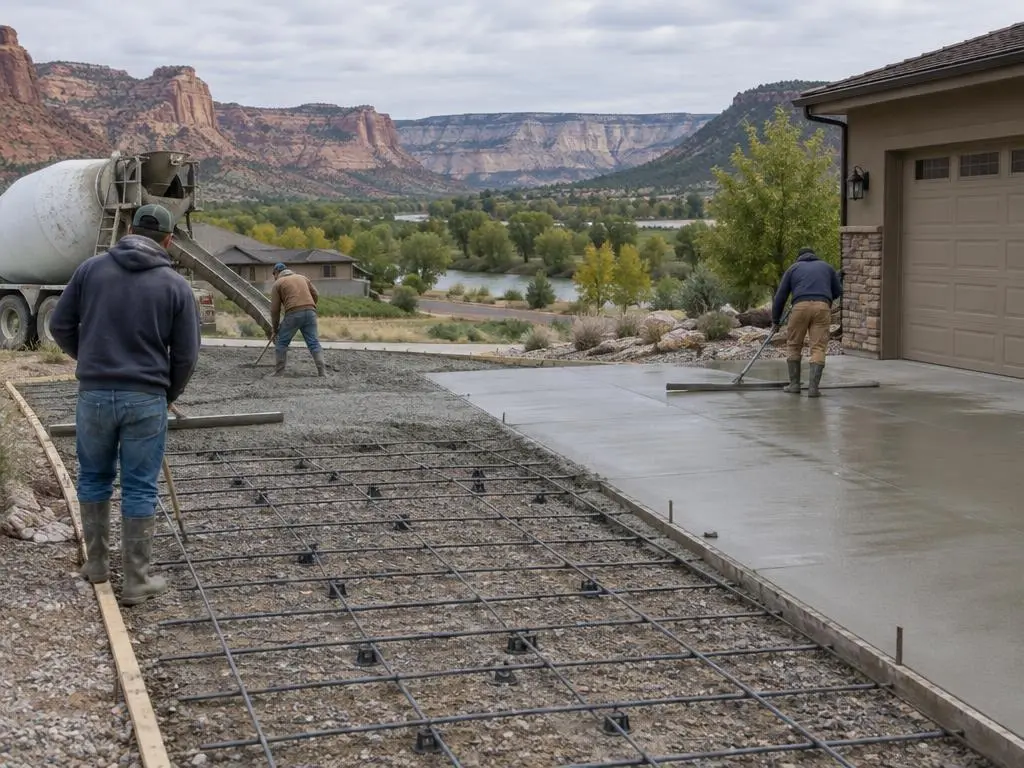
- Steel where loads justify it. Driveways and heavy pads get rebar raised on chairs to mid-depth instead of lying in the dirt.
- Joints drawn before the pour. Concrete shrinks and cracks. A planned joint layout gives those cracks straight, tidy places to form.
- Heat handled, not ignored. Summer pours start early, curing compound or wet curing goes on right after finishing, and nobody adds water at the chute to make the concrete flow easier.
Older homes, newer subdivisions
Census survey data puts the median Grand Junction home at about 1988, but the mix is wide. About 16 percent of homes were built in the 1970s, during the oil shale boom that ended with Exxon's pullout on May 2, 1982, the day locals still call Black Sunday. Close to 9 percent date to 1939 or earlier, and about 18 percent went up between 2000 and 2009. A 1970s driveway is now around 50 years old, often narrow, sometimes poured without air entrainment, and often sunk where it meets the garage. Newer homes have their own trouble: driveways and patios that settle where they cross backfill around the foundation, or crack beside a sprinkler zone that has run every summer since the house was built.
Our six services
- Concrete driveways: removal and replacement, widening, and extra parking for campers and trailers.
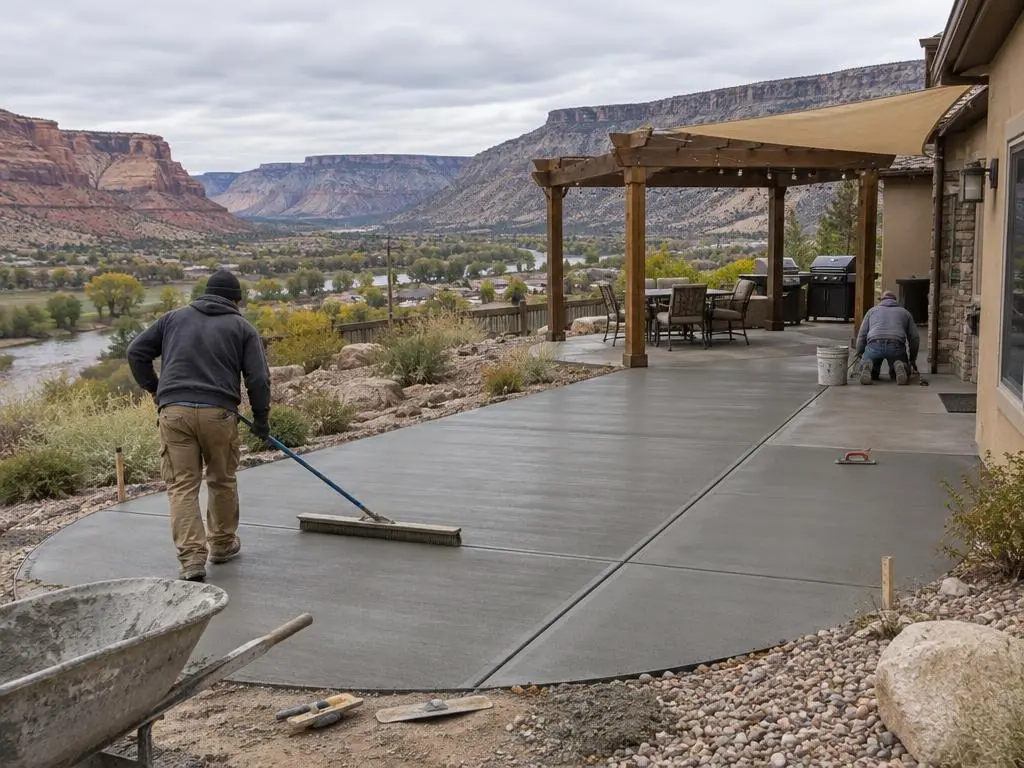
- Concrete patios: broom-finished, colored or exposed aggregate slabs, and add-ons to the patio you already have.
- Stamped concrete: flagstone, slate and plank textures with color mixed through, sealed against UV and freeze-thaw.
- Sidewalks and walkways: front entries, side-yard paths, and public sidewalk panels under the City's right-of-way permit.
- Concrete slabs: garage and shop floors, shed bases, RV pads, spa pads and equipment pads.
- Concrete repair: crack and joint sealing, resurfacing, lifting sunken sections, or tear-out when nothing else makes sense.
Permits and the city strip
Grand Junction's permits page states that any work inside the public right-of-way needs a right-of-way permit, and its examples include driveway changes, sidewalks, and curb and gutter. Applications go to the City's Engineering Division with a fee, a map of the work and a traffic control plan prepared by a traffic control company. When an apron, curb cut or front sidewalk is in the scope, we flag it at the estimate and list it separately. For anything entirely on private property, we confirm the rules with the City or Mesa County, depending on your address, before booking a date.
Pricing in writing
Every estimate is in person. We look at the existing concrete, the soil beside it and where the water goes, and then put the scope on paper: thickness, base, reinforcement, finish, joint layout and sealer, each on its own line so you can hold it up against another bid. Sometimes the honest answer is a tube of crack sealant or lifting one sunken panel, and when that is the case you will hear it from us. Call (970) 367-1391 to book a time.
Where We Work
Our main area is Grand Junction and the rest of the Grand Valley: Fruita, Palisade, Clifton, Fruitvale, Orchard Mesa, the Redlands, Loma, Mack, Whitewater and Glade Park. Up the Colorado and Plateau Creek we also cover De Beque, Mesa and Collbran. To the south, we take on work in Delta, Orchard City, Cedaredge and Olathe, and over in the North Fork Valley in Hotchkiss and Paonia. Not sure if your address is in range? Call (970) 367-1391 and ask.
- Concrete Contractors in Grand Junction, CO
- Concrete Contractors in Clifton, CO
- Concrete Contractors in Fruitvale, CO
- Concrete Contractors in Orchard Mesa, CO
- Concrete Contractors in Redlands, CO
- Concrete Contractors in Fruita, CO
- Concrete Contractors in Palisade, CO
- Concrete Contractors in Loma, CO
- Concrete Contractors in Mack, CO
- Concrete Contractors in Whitewater, CO
- Concrete Contractors in Glade Park, CO
- Concrete Contractors in Collbran, CO
- Concrete Contractors in De Beque, CO
- Concrete Contractors in Mesa, CO
- Concrete Contractors in Delta, CO
- Concrete Contractors in Cedaredge, CO
- Concrete Contractors in Orchard City, CO
- Concrete Contractors in Hotchkiss, CO
- Concrete Contractors in Paonia, CO
- Concrete Contractors in Olathe, CO
Why Homeowners Call Concrete Contractors Grand Junction
Water and drainage checked first
Most slab trouble in the valley starts with water getting under concrete. We look at sprinklers, downspouts and grade before anything else.
Mixes and joints for frost
Air-entrained concrete, planned control joints and a broom finish on exterior work, so winter freeze-thaw does less damage.
Summer pours planned around heat
Morning pours, damp curing and no added water at the truck, so fresh concrete does not dry out on a 94-degree afternoon.
A quote you can compare
Thickness, base, reinforcement, finish and right-of-way work listed line by line before you sign anything.
Common Questions
Do I need a residential concrete contractor or a general contractor for a driveway or patio?
For a driveway, patio, walkway or slab, a residential concrete contractor handles the whole job: tear-out, base, forms, reinforcement, pour, finish and curing. A general contractor usually makes sense only when concrete is one part of a bigger build, like an addition. We do residential flatwork across Grand Junction and the Grand Valley.
How much does concrete work cost in Grand Junction?
HomeGuide's national cost guides list standard-to-basic concrete driveways at $6 to $15 a square foot, plain patios at $4 to $12 and stamped patios at $9 to $30, and new sidewalks at $7 to $17. What you actually pay depends on tear-out, base work, access, thickness and finish, which is why our price comes after a site visit and in writing.
Why does concrete crack in the Grand Valley?
Usually water and soil. The Colorado Geological Survey lists Grand Junction among towns on Mancos or Lewis shale, which has swelling potential, and uneven wetting from sprinklers or downspouts makes soil move under one part of a slab. Winter freeze-thaw and fresh concrete drying too fast in summer heat add to it. A compacted base, good drainage, control joints and proper curing reduce cracking.
Do I need a permit for a driveway or sidewalk in Grand Junction?
The City of Grand Junction requires a right-of-way permit for any work in the public right-of-way, including driveway changes, sidewalks, and curb and gutter, handled through its Engineering Division. Work entirely on your property may have other rules depending on whether you are in the city or unincorporated Mesa County. We check before we schedule.
When is a good time of year to pour concrete here?
Spring and fall are easiest. Grand Junction's average last freeze is around April 25 and its first freeze around October 11, and summer brings many days over 90 degrees. We pour all season, using morning pours and damp curing in summer, and blankets or a heated mix if a fall job runs into cold nights.
Should I repair or replace my driveway?
A few hairline cracks, a chipped edge or one dropped panel are usually repair jobs: seal it, patch it or lift it. HomeGuide's leveling guide draws the line at cracks wider than a quarter inch, heavy spalling or surface damage, and concrete that is badly deteriorated; past that point, replacement is the better buy. We will tell you where your driveway falls.
How long before I can drive on new concrete?
Walking on it is usually fine in a day or two, and a car can go on after about seven days. Hold off longer with pickups pulling trailers or with an RV, since concrete is still gaining strength for roughly four weeks. Your pour date and the weather decide the exact days, and we write them down for you.
Concrete Services in Grand Junction
Driveways, patios, stamped work, walks, slabs and repair. Each one gets a written quote after we have seen the site.
Concrete Driveways
Replacement and new driveways on compacted gravel, with rebar, an air-entrained mix and a pitch that sends water to the street.
Learn more →Concrete Patios
Broom-finish, colored and exposed aggregate patios sloped away from the house, with joints and thickness planned for furniture, grills and hot tubs.
Learn more →Stamped Concrete
Stone, slate, flagstone and wood-plank patterns in integral color for patios, walkways and driveways, sealed against sun and frost.
Learn more →Sidewalks & Walkways
Front walks, side-yard paths and city sidewalk panels, poured with a compacted base, proper slope and broom finish for safe footing.
Learn more →Concrete Slabs
Garage floors, shed and shop pads, RV pads and equipment slabs, sized and reinforced for the load they will carry.
Learn more →Concrete Repair
Crack sealing, joint caulking, resurfacing and leveling of sunken panels, with an honest answer on when replacement is the better buy.
Learn more →Get a Free Concrete Estimate in Grand Junction
Driveway, patio, walk, slab or repair: describe the job and we will measure it and put the price in writing.